Iona Abbey

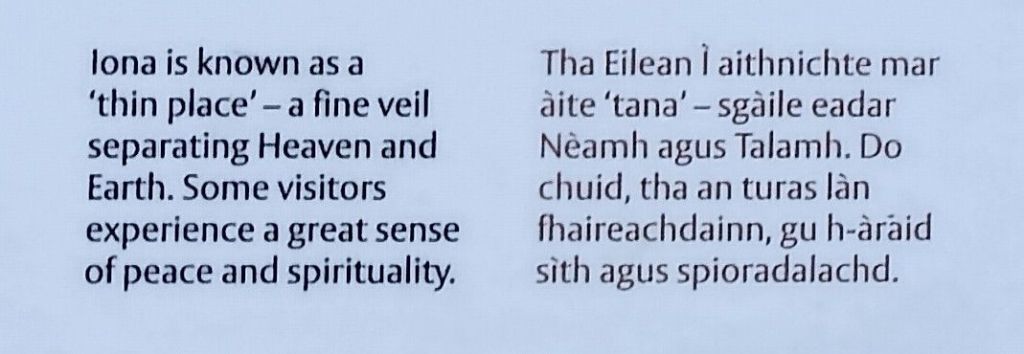
Iona! This little island sits off Mull which sits off the Scottish mainland. It’s not a terribly large island, being only about three miles from its northern beaches to its southern tip and about a mile and half at its widest. This little isle has a large following as one source cites that 130,000 will visit Iona in any given year. It is often described as a ‘thin place.” if that term is new to you, the best definition I’ve discovered is on a plaque (located on a path to Iona Abbey.
A brief history of Iona.
The story begins with Crimthann (521-597 CE), son of Fedlimid mac Fergus Cennfota and Eithne of the Cenél nÉnda. His great-great grandfather was Niall of the Nine Hostages, an iconic figure in Irish history. Crimthann was well educated as a member of a high noble family. He entered into a religious vocation in his early twenties, took on the name Colum Cille (which means ‘dove’ the Latin derivative of his.name is more familiar, most know him as St. Columba) and studied under several notable clerics including Finnian of Moville.

According to legend, while under the tutelage of Finnian, Colum Cille secretly copied a psalter and attempted to keep it for his own. Finnian disagreed. In 561, the “Battle of Cúl Dreimhne” (“Battle of the Book/Psalms”) resulted in the deaths of over 3000 Christians from both battle lines. As his penance, Colum Cille entered a self imposed exile from Ireland with the understanding that he would not return until having converted a similar number Scots and Pics to Christianity.
He asked and was granted the Isle of Iona by the king of Dal Raita. This kingdom spanned the southwestern portion of Scotland and the northwestern portion of Ireland. In 563, Colum Cille arrived on the southern point of Iona with twelve monks and began work in building a religious community following the Celtic form of a Christianity that was common in his native Ireland.
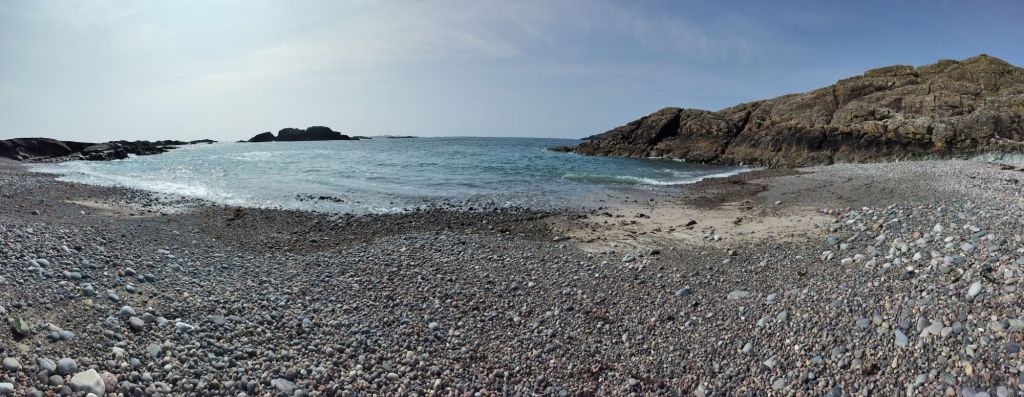


Iona Abbey sits on the east side of the island off the Sound of Mull. Next to the Abbey is a small hill which once was topped with a hut. The ‘Tòr An Aba’ (Hill of the Abbott) from which Colum Cille could see all around at the workings of the abbey. It was his scriptorium (place to copy manuscripts), and sleep.

Iona would become the birthplace of Scottish Christianity and as such carries a lot of significance to the church today. Indeed from this small island, Scotland was effectively evangelized. Following his death, pilgrims would come to the island. Jacki and I came to Iona the first time in 2012 and we’ve returned, this is our third trip to Iona. People still throng to Iona and currently the Iona Community maintains an active presence providing retreats, daily worship and prayer service and strongly advocating for peace and justice.
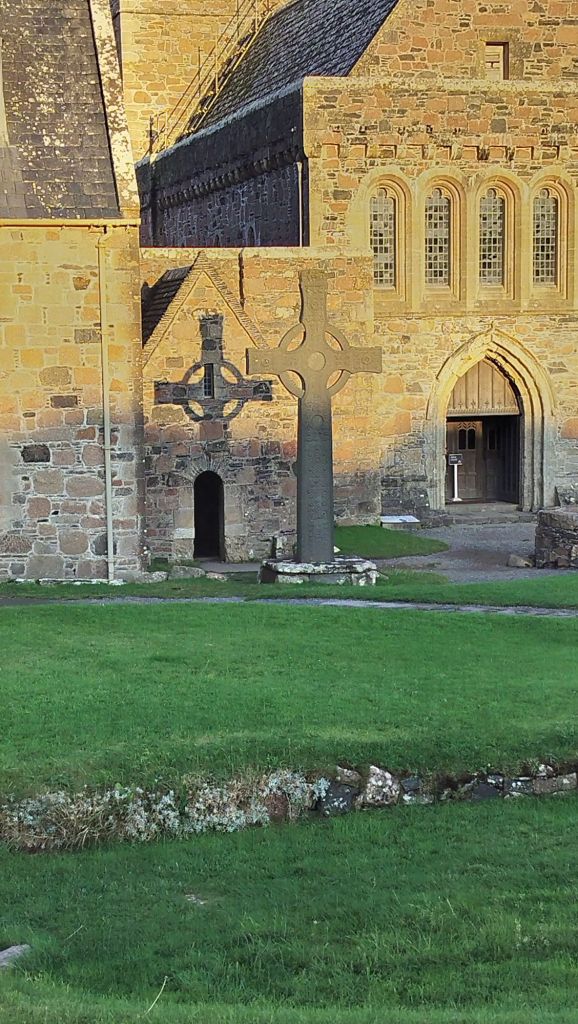
A small chapel sits on the side of Iona Abbey and it is believed that this was where the saint was laid to rest. On our first day, I took a stroll in the evening to the Abbey at just the time that the sun was setting and caught the shadow of the large Celtic cross whose shadow was resting on the chapel. There was something peaceful about that image, the sun setting beyond the hill and the cross’ shadow resting on the resting place of the saint.
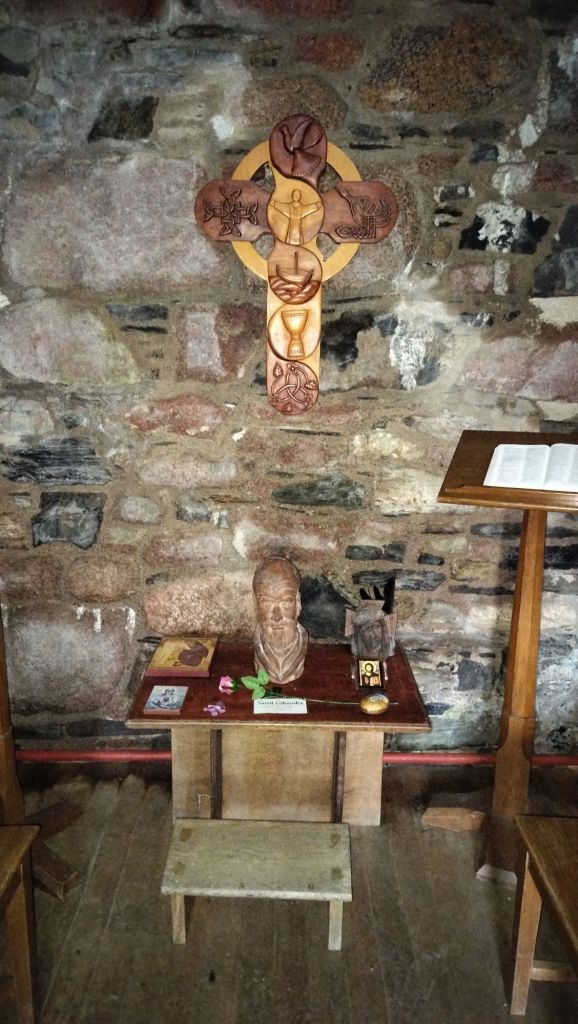
Iona is considered a thin place. I wonder if it is because something metaphysical is rooted here. Are there places where heaven is closer to the earth? It is not like our mind can conceive it but it is something that one feels. Perhaps it is because this place induces one to worship or pray while standing in ancient buildings or natural settings of beaches, lakes and mountain (both smooth and craggy). And because humans have been doing this for centuries, those acts of sacred beauty rub off upon the environment leaving a sense that heaven and earth are thinly separated in such a place.
 So(ul)journ!
Leave a comment