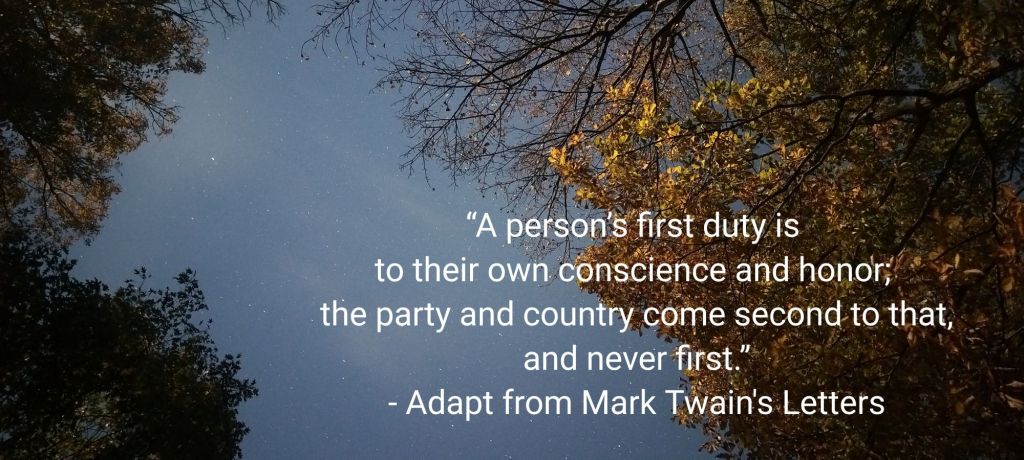
“A person’s first duty is to their own conscience and honor; the party and country come second to that, and never first.”
— Adapted from Mark Twain’s letter to W. D. Howells, September 17, 1884
Over the last few weeks, my mind has been trying to flesh out a thought. I’d like to take you on a journey of a different sort. This trip isn’t to an exotic place or some grand adventure. Rather, it is a journey into the very center of who we are and who we aspire to become. To be fair, I’m not a sociologist or a psychiatrist, but I have spent much of my life observing people, and I know one quite intimately.
He is quite fallible, can be moody at times, and can cuss like a sailor, dropping F-bombs when words fail to arrive in time to keep the moment civil. When choosing a name for his arrival into grandparenthood, his mother-in-law labeled him “Grumps” quite by mistake as she tried to recover from her slip with “Gramps.” The name, however, had been unleashed as if written in the Book of Life, from Jane’s lips to God’s ears. Yes, in my most base nature, Grumps rears his ugly head. But that is only a small part of me. I believe I have some redeeming qualities, and for those that betray me, I trust that grace reigns.

Anyways, back to “The Thought.”
It began as I started to dwell on my personal frustration with the political situation in these seemingly dis-United States. I continue to observe various social platforms, newsreels, talking heads, television commercials, and articles, and how all of this influences us to participate in pointing out the negative qualities of the opposition and their supporters. We have become a people who seem more motivated by what we oppose than by what we believe to be true, right, and honorable.
As a community, we may profess such values. We can add to them other virtues such as honesty, compassion, and justice. Yet when it comes to choosing someone to lead us, we are seemingly willing to set aside those very values in favor of power, protection, personal advantage, or simply a sense of belonging.
The character of a leader becomes evident in the exercise of power. The character of the people who entrust that leader with power is revealed in the choice itself.
Should it surprise us that we are quick to judge the morals of a leader by what that leader does—or doesn’t do? Perhaps we ought to turn the mirror on ourselves and consider the morality of a people who knowingly place that leader in such a position.
Oh, I’m not satisfied with that choice of words. The process of thought works, but using the word “morals,” or even “morality,” doesn’t quite capture the sense of what I’m struggling to name. Morality and morals can be subjective. What one person considers immoral, another may consider justifiable or even necessary. And morality can be too easily compartmentalized. People can condemn behavior in one part of their lives while finding ways to excuse it when it comes to their political choices. We may recognize something as wrong in another person while being willing to overlook the same behavior in ourselves—or in someone we support. In doing so, we find ourselves sacrificing in our own choices what we are so quick to demand of others.
I’ve opened up a thesaurus, and other words have begun to resonate with what I’m trying to hone in upon.
“Ethics” might be the word. We generally have personal ethics we hold dear, and yet we can find ourselves willing to sacrifice them for some perceived greater good. “The boss encouraged me to bend the truth because they wanted the sale to go through, so I caved.” We know the principle, and we know the compromise. We may even have a good reason for making it. But does that make the compromise any less consequential?
“Integrity” is another good word choice. It is something we often recognize in others, a quality evidenced by the way they act. We say, “That person has integrity because I’ve seen it in the way they live.” Integrity is the consistency between what we profess to believe and how we actually behave. It is not simply a label we give ourselves. It is something that becomes visible in our actions.
“Conscience,” however, quickly rose to the top of the list. It is that inner ability to discern right from wrong, that voice that challenges us when our actions and our convictions are not in agreement. Think of Jiminy Cricket perched on Pinocchio’s shoulder, trying to guide him along the right path. Pinocchio’s growing nose, each time he fails to tell the truth, becomes a visible reminder of the consequences of his choices. Through his missteps, he slowly learns the ramifications of wrong behavior and the importance of recognizing what is right.
Perhaps conscience is the word I’ve been looking for. At least it will sit with me for the time being. It isn’t simply about knowing right from wrong. It is about being willing to listen to that inner voice, especially when doing so is inconvenient, uncomfortable, or costly. Conscience is not tested when it agrees with our loyalties. It is tested when it challenges them.
We are often judged by the character of our leaders, and yes, perhaps we should pay closer attention to the character of those of us who choose them. In recent weeks, we have seen reports of Republican political leaders at rallies displaying deeply troubling behavior, from out-and-out lies to inappropriate sexual conduct on stage. We have also seen news reports of an unfolding political drama in Alaska, involving allegations that Democratic Party officials and campaign staff worked to create a larger pool of political rivals against an incumbent senator in the hope of making their own candidate more viable in a ballot election. Whether or not such tactics violate the law is a separate question from whether they reflect the principles we expect our political leaders to uphold. Something can be legal and still be wrong.
The election of a leader reveals something about the values of those who entrust that person with authority. And the willingness of an opposing party to manipulate the same process reveals something about its values as well. We cannot demand accountability from one side while making excuses for the other.
We should all be deeply troubled by the President’s leadership and the direction of the Republican Party, and at the same time be concerned by the tactics employed by Democrats to gain political power. These positions aren’t contradictory. Both circumstances can exist, and acknowledging one does not require us to excuse the other. There is an uncomfortable tension here because, regardless of which party we support, we are challenged to examine our own political loyalties. May our loyalty never be greater than what our conscience dictates.
Shouldn’t it be better to be disappointed by the actions of a party we support than to become so loyal to it that we can no longer recognize when it has abandoned its principles? Most certainly, we began supporting a party because it represented something we believed in. Sometimes, however, we find ourselves defending the party when its actions contradict the very principles that attracted us to it in the first place.
When our team has failed us, where do we turn? Do we simply find another team? At this point, the Independents may be raising their hands. But I also know that change happens from within, not simply by stepping away. No criticism intended toward those who choose to leave a party or become independent. It has been my experience that the only way an organization can truly reform is when its membership chooses to stay engaged and work for change. Sometimes conscience calls us to walk away. At other times, it calls us to remain and insist that the organization live up to the principles it claims to represent.
Perhaps what we need is not a new political team, but a different understanding of what it means to belong to one. We need fewer political loyalists and more citizens of conscience.
At this point, it seems we ought to reconsider who—or what—deserves our loyalty. Our political affiliations may be expressions of our deeply held convictions, but they should never become the owners of those convictions. Our conscience belongs to us. It is our responsibility to listen to it, to examine our choices, and to hold ourselves accountable before we hold others accountable.
My parents raised five boys to manhood. They taught us to know right from wrong and that wrong behavior brought consequences. They even provided a disclaimer as they sent us into the world: should we determine to go down a path that resulted in negative consequences, we were not to come back and attempt to blame them, because they had raised us correctly. Thus far, we have all managed to stay out of prison—or at least none of us has admitted to serving time.
My parents also impressed upon us that we would be known by the company we keep. So far, that has worked for us, although the current political climate has stretched the extremes, since my brothers and I all sit on separate sides of the political aisle, as many families do in this nation. We have managed to maintain our relationships despite our political differences. Yet I wonder whether we have been as willing to hold our own political company accountable as we have been to judge the company kept by others.
Knowing right from wrong is one thing. Having the courage to apply that understanding consistently is another. Perhaps my brothers and I, like so many of us, have found ways to exempt our own political choices from the very standards we were taught to uphold. It is easier to recognize the failures of those on the other side of the aisle than to acknowledge the failures of those with whom we stand.
And perhaps that is where this journey brings me back to where it began—with the person I know quite intimately. Grumps is still there. He can be impatient, judgmental, and altogether too willing to see the faults of others before recognizing his own. I suspect he is not alone.
We need not abandon our political convictions or affiliations to exercise independent judgment. Nor must we agree with one another about every question of right and wrong. But we must be willing to hold ourselves, and those who claim to represent us, to the principles we profess. We should be known not only by the company we keep, but by the standards we are willing to uphold within that company.
A loyalist defends the team. A citizen of conscience holds the team and themselves accountable.
And perhaps that is a good place for all of us to begin.



Leave a Reply